The sealing of posts without concrete remains allowed, even in seismic zones, provided that certain technical specifications are respected. Alternative techniques are gaining ground, driven by the search for savings and the desire to limit environmental impact. Despite misconceptions about the fragility of these installations, several systems demonstrate strength equivalent to traditional methods.
There are suitable solutions for every type of soil, including loose or stony ground. However, alignment or fastening errors can compromise the stability of a fence without concrete in the long term.
Why choose a fence without concrete? Advantages and misconceptions
The fence without concrete has now established itself as a popular option, driven by the desire to limit environmental impact and optimize budgets. The ecological argument is significant: without concrete, there is no polluting production and accumulating waste. In gardens, this lighter installation respects soil life and preserves biodiversity. Another notable advantage is the speed of installation: a flexible or rigid mesh without cement can be quickly assembled, reducing physical effort in the process.
Lower costs, simplified dismantling, flexible installation: the fence without sealing meets many often underestimated needs. Delimiting a space, securing a plot, all of this becomes accessible without resorting to construction machinery.
Here are different systems to achieve this:
- Galvanized or aluminum metal posts,
- Drive-in anchor,
- Foundation screws:
each solution aims for resistance, without relying on masonry. Galvanized steel models, in particular, stand strong against rust and endure through the years without flinching.
Some clichés are hard to shake: the fence without concrete is seen as a temporary option or reserved for small spaces. Yet, up to 1.80 meters high and outside of areas with strong winds, strength and aesthetics match those of traditional sealing. Treated wood, composite, aluminum, mesh: the variety of materials offers a wide range of styles, catering to both DIY enthusiasts and more advanced landscaping projects.
To delve deeper into the techniques, the article how to make a fence without concrete provides a comprehensive overview, with practical advice to ensure the strength and longevity of your installation.
What tools and materials to prepare for installing a rigid mesh without concrete?
The installation of a rigid mesh without concrete relies on a precise choice of classic tools and anchoring systems suited to the terrain. On loose or clayey soil, the drive-in anchor advantageously replaces the concrete foundation. This method preserves the soil structure while ensuring the stability of the posts. If the fence needs to rest on a slab or low wall, the screw plate is essential, ensuring anchoring without clearing or mixing cement. The foundation screws come into play where classic tools struggle to penetrate, especially on difficult terrains.
The choice of rigid panels and galvanized steel or aluminum posts makes all the difference in terms of weather resistance. Materials treated against corrosion ensure considerable longevity. On damp ground, treated wood or aluminum are favored, provided that the parts in contact with the earth are protected with a geotextile or insulating film.
To successfully carry out the installation, prepare the following equipment:
- Mining bar or auger for working the soil,
- Mallet for driving in anchors,
- Level to check verticality,
- Measuring tape and chalk line for alignment,
- Shovel, pickaxe, and tamper for final adjustments.
Gravel improves drainage, compact soil firmly holds the posts, while bracing reinforces angles and ends. On sandy ground, it is advisable to use winged sleeves, driven in 70 cm for optimal support. On clayey soil, prefer the wide spiral foundation screw. Together, they form a modular system that is easy to dismantle and rivals traditional concrete sealing without shame.
Detailed steps for a successful installation and tips to avoid common mistakes
The installation of a fence without concrete begins with the preparation of the ground. Measure the space to be fenced precisely with a measuring tape, stretch a chalk line, and mark the points with a pencil. This rigor in marking conditions the future straightness of the fence. Identify the characteristics of the terrain: elevation, soil type, presence of stones or roots.
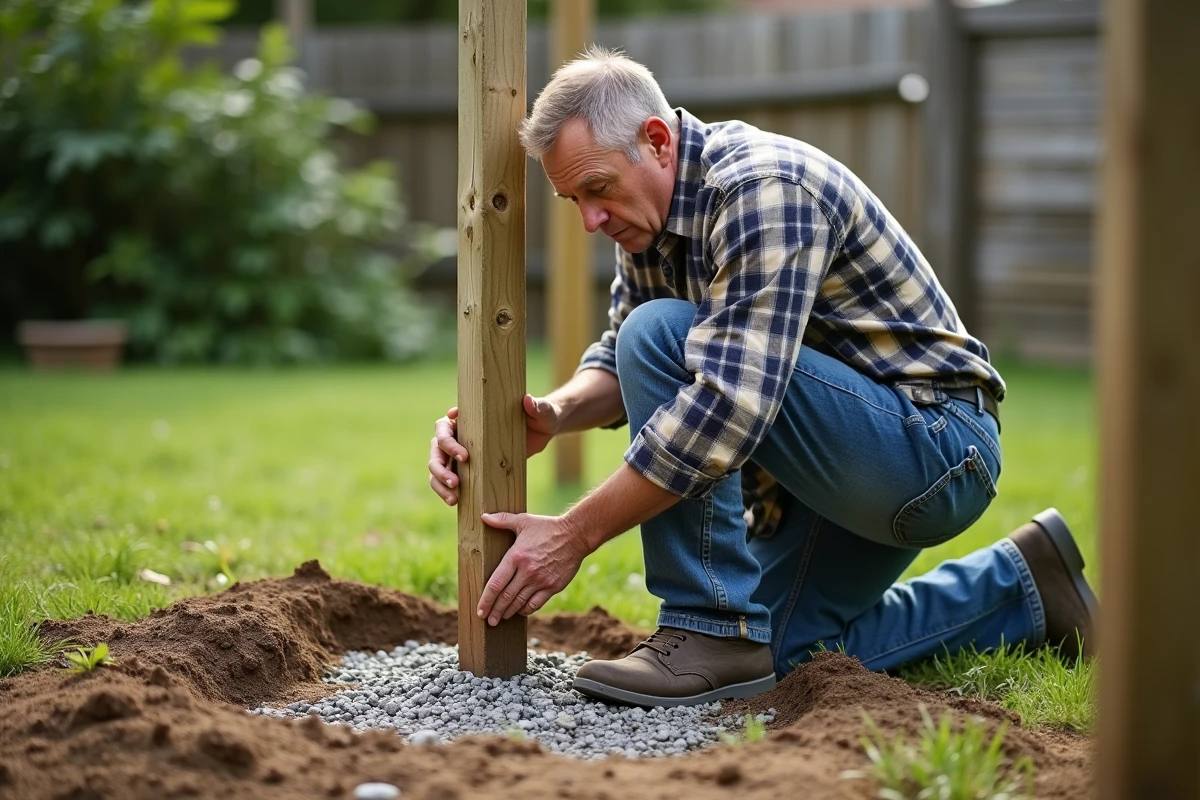
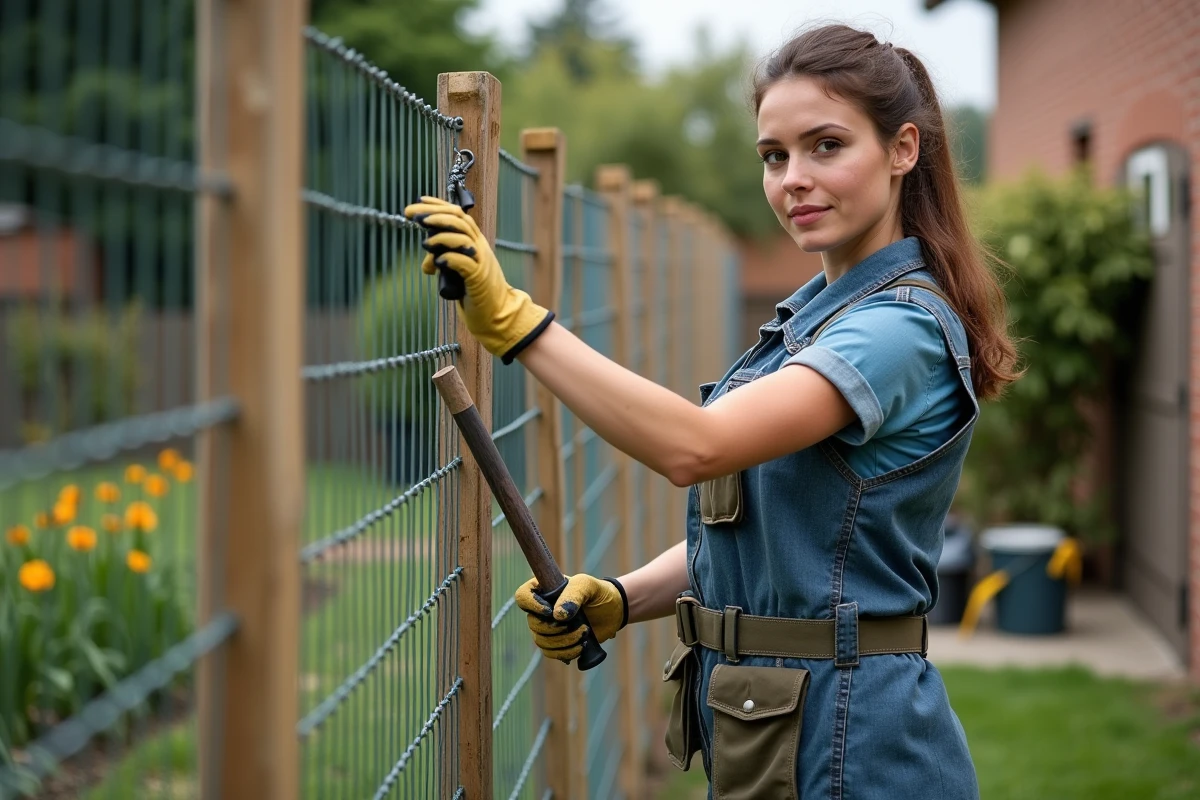
For the installation of a rigid or flexible mesh, holes need to be dug at regular intervals, suited to the length of the panels or rolls. An auger or mining bar makes the work easier, especially on compact soil. Place the posts or stakes ensuring their perfect verticality, checked with the level. On clayey soil, the foundation screw offers very good results; on sandy terrain, the winged sleeves are driven in 70 cm for impeccable support.
Remember to use gravel to promote drainage and stabilize the anchors. Carefully compact the soil around each support, step by step. For angles and ends, do not forget to install bracing: they prevent deformation, especially when the fence is under tension.
A tension wire, well stretched and aligned, ensures the stability of the flexible mesh. To secure animals, choose sturdy stakes and an appropriate mesh. If privacy is desired, a privacy screen can be easily added to the existing structure.
Check the verticality and straightness at each stage of the project. Poor alignment or poorly compacted support weakens the structure. Experience shows that precision and patience are the allies of a durable fence. In the end, the fenced area displays a straight, solid, and harmonious line, ready to withstand the seasons.